



A Will Eternal — Chinese Cultural Concepts (Chapters 1–10)
What this is: a reference list, not a summary. These are the Chinese cultural concepts, objects, and ideas that appear in chapters 1–10 of A Will Eternal and that a Western reader has no way to decode from context. Each entry explains where the concept comes from in Chinese culture, why the English translation cannot carry it, and what it is doing in the novel.
How to use it: read an entry when a chapter throws a term at you that the translation leaves unexplained. Concepts are grouped roughly by the chapter where they first matter.
长生 (CHÁNGSHĒNG) — “Long Life” / Physical Immortality
Category: 概念 · Core worldview
The novel’s entire premise rests on this word, and it is the single most misunderstood term in the book.
Western readers hear “immortality” and reach for the Christian frame: eternal life granted by God, received after death, a condition of the soul. 长生 is none of those things. It means long life — specifically, extending your physical lifespan while you are still alive, in your body, through your own effort.
| Western “immortality” | Chinese 长生 |
|---|---|
| Gift of God | Achieved by personal practice |
| Begins after death | Begins and continues in the body |
| A state of the soul | A project of the body |
| Free, by grace | Paid for in decades of effort and danger |
So when fifteen-year-old Bai Xiaochun is sent off with the words “go become an immortal, then you can live forever,” he is not being promised salvation. He is being told to go get a very long education. Chinese cultivation fiction is, at bottom, a fantasy about lifespan as a measurable, earnable resource — and the whole plot engine of A Will Eternal is that Bai Xiaochun wants more of it than anyone, and is more frightened of losing it than anyone.
仙 (XIĀN) — The Immortal
Category: 概念 · Archetype
The 仙 is the goal-state of a cultivator: a human who has refined body and spirit past the limits of mortality and become something else — powerful, long-lived, often capable of flight.
Crucially, a 仙 is not a god. There is no divine authority behind it, no grace, no worship. A 仙 is closer to an extraordinarily accomplished professional. Chinese immortals gamble, bicker, hold grudges, run institutions, and get tired.
When Li Qinghou flies down in chapter 1, exhausted and annoyed after three years of being summoned, he is behaving exactly like a 仙 is supposed to behave in this tradition: an overworked senior colleague, not a divine messenger. Western readers expecting Gandalf find a tired bureaucrat — and that mismatch is the point.
一炷香 (YĪ ZHÙ XIĀNG) — “One Stick of Incense”
Category: 器物 / 计时单位 · Timekeeping
A unit of time measured by how long one incense stick takes to burn — roughly 30 minutes, though it varies with stick size and airflow.
Before clocks, temples and households measured intervals this way: not by abstraction, but by a physical object consuming itself. The phrase survived into modern Chinese as a casual way of saying “a while.”
Why Western readers trip on it: English translations render it “one stick of incense,” which sounds like a substance, not a duration. When the novel says “he stood there for 一炷香,” English readers often read it as “a moment.” It actually means half an hour of standing there deliberating — a meaningful amount of time.
香 (XIĀNG) — Incense as Communication
Category: 器物 · Ritual
Incense in Chinese culture is not mainly a scent. It is a transmission medium — the standard way to contact ancestors, deities, and the dead. You burn it to send a message upward.
Bai Xiaochun’s black incense stick (传信香, chuánxìnxiāng — “message-transmitting incense”) is therefore not a magic wand. It is a letter, an inherited IOU from an immortal who once owed his family a favor. Every time he lights it, he is mailing a request. The three years of unanswered letters is not just comedy — it is the failure mode of a ritual that the whole society takes seriously.
The same object later becomes the incense ingredient of alchemy. Incense and pills are the two delivery systems of the same science.
仙人 / 修士 / 凡人 (XIĀNRÉN / XIŪSHÌ / FÁNRÉN) — The Three-Tier Social Order
Category: 概念 · Social structure
The novel’s world divides people into three ranks, and the vocabulary is consistent everywhere:
| Chinese | Meaning | Status |
|---|---|---|
| 凡人 (fánrén) | “ordinary person” / mortal | Outside the system entirely |
| 修士 (xiūshì) | “cultivator” / one who practices | Inside, low rank |
| 仙人 (xiānrén) | “immortal” | The far goal |
Note that 凡人 does not mean “weak.” It means outside the game — someone for whom lifespan is a fixed, unalterable number. The emotional weight of being 凡人 is not powerlessness but a closed ledger: your time is already counted and you cannot appeal.
This is why Bai Xiaochun’s parents’ early death haunts him specifically. In a world where lifespan can be extended, being 凡人 means watching the people you love run out of time with nothing you can do about it.
凝气 (NÍNG QÌ) — “Qi Condensation”
Category: 概念 · Cultivation realm
The first realm of cultivation, with ten layers. 凝气 literally means “condensing qi” — taking the diffuse life-energy of Heaven and Earth and accumulating it into a usable reservoir inside your body.
Why it is not “magic”: qi is not mana and has no spell slots. It behaves more like stamina, blood pressure, and vital force combined into one measurable resource. You do not cast from it; you are it. Strength, endurance, healing, and eventually lifespan all track your qi reservoir.
The key threshold of the opening arc: 凝气三层 (Layer 3) is the minimum requirement to attempt the Trial Road. Everything in chapters 1–13 — the Fire Kitchen’s cushy life, the spot-selling scheme, Bai Xiaochun’s entire motivation — orbits that single gate.
修炼 (XIŪLIÀN) — Cultivation as Practice, Not Study
Category: 概念 · Method
Western fantasy heroes learn magic from books or are born with gifts. Cultivators practice — the same postures, breathing patterns, and qi-circulation routes, repeated daily for decades, wearing the body into a stronger shape.
The word 修炼 is built from 修 (“to repair, to refine, to cultivate”) and 炼 (“to smelt, to temper by fire”). Both are artisanal verbs. The same characters appear in 炼灵 (Spirit Enhancement) and 炼丹 (pill refining). The novel is quietly telling you that cultivation, smithing, and alchemy are the same act performed on different materials — you, metal, and herbs. That is not a metaphor the translator invented; it is in the language.
气 (QÌ) — Qi
Category: 概念 · Core metaphysics
The life energy saturating Heaven and Earth (天地), absorbed into the body through breath and posture, then circulated along fixed routes.
Do not translate it as “energy” in the sci-fi sense. Qi is closer to a hybrid of breath, blood, and vitality — something you can be full of or depleted of. Chinese medicine treats illness partly as qi blockage; martial arts treat power as qi circulation. Cultivation fiction takes both literally and makes qi a quantifiable substance you can accumulate, spend, and lose.
丹田 (DĀNTIÁN) — “The Elixir Field”
Category: 概念 · Anatomy
The body’s qi reservoir, located roughly three finger-widths below the navel. The name decomposes as 丹 (“elixir, cinnabar pill”) + 田 (“field”) — literally “the field where the elixir is grown.”
That etymology matters: it tells you that in this tradition, the body is farmland and the pill is a crop. The inner elixir (内丹) is cultivated inside you; the outer elixir (外丹) is refined in a furnace. Bai Xiaochun’s later career as a pill-refiner is not a side quest — it is the outer half of the practice whose inner half everyone else in the sect is doing.
经脉 (JĪNGMÀI) — Meridians
Category: 概念 · Anatomy
A network of channels through which qi flows, described in traditional Chinese medicine. Blockage causes illness; free flow causes health.
In cultivation fiction, a technique is essentially a meridian-circulation program — instructions for routing qi along a specific path in a specific order. This is why a technique can be wrong and injure you, and why mastering one is a matter of precision rather than belief. When Bai Xiaochun later adjusts a formula or invents a route, he is doing something closer to programming than to spellcasting.
天材地宝 (TIĀNCÁI DÌBǍO) — “Heavenly Materials and Earthly Treasures”
Category: 概念 · Resource class
The standard term for rare natural resources that contain concentrated qi: unusual herbs, minerals, spirit fruits, animal parts. Literally “Heaven’s materials, Earth’s treasures.”
These are the raw materials of cultivation, and their scarcity is what makes cultivation economics function. Note the phrasing: resources are described as Heaven’s and Earth’s — the world’s private property, not humanity’s. Taking them is not neutral. This vocabulary quietly sets up the central tension of Spirit Enhancement, where the universe is treated as a treasury that someone has been robbing.
炼灵 (LIÀN LÍNG) — Spirit Enhancement
Category: 概念 · The core mechanic
The novel’s signature power: forcing the energy of Heaven and Earth into an object so that it becomes fundamentally stronger.
Break the term down: 炼 (“to smelt, to refine by fire”) + 灵 (“spirit, spiritual essence”). It is metalworking performed on spirit.
| Aspect | Detail |
|---|---|
| Valid targets | Pills, incense, weapons, artifacts — anything |
| Legal status | Forbidden by Heaven and Earth |
| Success | Item becomes vastly stronger, often multiplicatively |
| Failure | Item is permanently destroyed |
| Repetition | Possible, but success rates collapse each time |
| Ceiling | Ten successful enhancements cause a world-shaking transformation |
Why Western readers consistently misread this: in Western fantasy, enchanting a sword +10 is neutral craftsman’s work. Here, Spirit Enhancement is framed from the first appearance as theft — extracting power the universe never consented to give. The cost is not mana. The cost is the cultivator’s own lifespan (寿元).
寿元 (SHÒUYUÁN) — Lifespan as a Currency
Category: 概念 · The moral core
The single most important concept in the novel, and the one English readers most often skate past.
寿元 means lifespan, the total allotment of years you have to live — and in this setting it is not a fixed number but a drainable resource.
A cultivator’s 寿元 can:
- Be lost — paying the price for forbidden acts like Spirit Enhancement
- Be restored — through rare pills and advanced realms
- Be extended — dramatically, at each major breakthrough (Foundation Establishment adds at least a hundred years)
The physical proof in the novel is Bai Xiaochun’s single white hair — a visible marker of a year he has spent. When his hair returns to black in chapter 17, he has clawed a year back. The entire emotional arc of the opening 50 chapters runs on this ledger.
The cruel irony at the heart of the book: the tools that let him gain more life cost him the very thing he is trying to accumulate. Time buys the ability to earn time. He is spending the treasure to buy the shovel.
天地不允 (TIĀNDÌ BÙ YǓN) — “Heaven and Earth Do Not Permit It”
Category: 概念 · Cosmic law
The phrase that governs Spirit Enhancement, and one of the most culturally loaded formulations in the novel.
In Chinese cosmology, 天地 (Heaven and Earth) is not a deity but the total order of the universe — natural law, fate, and the moral structure of things all folded together. To say something is 天地不允 is to say it violates the fundamental arrangement of reality.
Note the absence of a lawgiver. No one forbids Spirit Enhancement; the universe simply does not allow it. And the enforcement is automatic — a debt is created and collected in 寿元. This is a very Chinese way of framing transgression: not sin against a person, but imbalance against a system that will rebalance itself.
鼎 (DǏNG) — The Ritual Cauldron
Category: 器物 · Civilizational symbol
Nothing in the novel is more consistently underestimated by English readers than the 鼎.
A 鼎 is a three-legged bronze ritual vessel used in ancient China for offerings to ancestors and Heaven. Over centuries it accumulated meanings so heavy that a single character now carries all of the following at once:
| Layer | Meaning |
|---|---|
| Bronze Age ritual | The vessel for offerings to ancestors and Heaven |
| Sovereignty | The Nine Tripods (九鼎) symbolized the mandate to rule China |
| Idiom 问鼎 | “To ask about the tripods” = to covet the throne |
| Idiom 一言九鼎 | “One word weighs as nine tripods” = absolute trustworthiness |
| Daoist alchemy | The vessel in which elixirs are refined |
So when Xiangyun Mountain’s sacred artifact is a 鼎, and when Bai Xiaochun’s foundational art is 紫气驭鼎功 (“Purple Qi Cauldron-Mastery Art”), the Chinese reader is processing authority, sacredness, transformation, and alchemy simultaneously.
English “cauldron” evokes a witch’s pot. The gap is enormous. If you remember one thing from this list: the 鼎 is not cookware; it is a national treasure.
紫气 (ZǏ QÌ) — “Purple Qi,” the Auspicious Omen
Category: 概念 · Symbolism
Purple qi is a classical Chinese omen of the arrival of a sage. Its most famous source is the story of Laozi crossing the Hangu Pass, where a guard saw 紫气东来 — “purple qi coming from the east” — and knew a great sage was approaching.
Naming a foundational technique “Purple Qi Cauldron-Mastery” is therefore a claim, not a description: this art is classically, legendarily auspicious. Purple in Chinese elite symbolism signals nobility and sacred arrival — a different register entirely from the “dark/mysterious” purple of Western fantasy.
举重若轻 / 举轻若重 (JǓ ZHÒNG RUÒ QĪNG / JǓ QĪNG RUÒ ZHÒNG) — The Mirrored Idioms
Category: 概念 / 成语 · Aesthetic principle
Two genuine Chinese idioms, used in the novel as named tiers of the same technique — and English readers almost always assume they are simply opposites.
| Idiom | Literal | Real meaning |
|---|---|---|
| 举重若轻 | “lift heavy as light” | Mastery so deep it looks effortless |
| 举轻若重 | “lift light as heavy” | Control so absolute that even a trivial motion carries full precision |
These are not opposites. They are two halves of the same ideal: the first is about power made invisible; the second is about precision made total. Together they describe the classical Chinese aesthetic of the expert — someone for whom nothing is careless and nothing is strained.
In the novel, mastering both lets Bai Xiaochun unleash the art’s single true technique. The pairing is deliberate, elegant, and almost entirely lost in translation.
道 (DÀO) — The Way
Category: 概念 · Philosophy
The root concept of Taoism: the underlying order and natural course of all things. Its core idea is effortless alignment — the sage does not force the world but moves with it (无为, wúwéi).
Cultivation fiction inherits this wholesale. To cultivate is to align with 道; to defy it is to invite ruin. This is the philosophical frame beneath Spirit Enhancement: Bai Xiaochun is not breaking a rule, he is forcing the world out of its natural course — and the world charges him for it. The 逆鳞 (reverse scale) imagery of the setting — the dragon’s single scale that drives it berserk when touched — comes from the same idea of an order with a hard limit.
鱼跃龙门 (YÚ YUÈ LÓNG MÉN) — “A Fish Leaping the Dragon Gate”
Category: 成语 · Social metaphor
The standard Chinese idiom for a once-in-a-lifetime jump in status — a nobody becoming a somebody.
Its origin: legend says that at the Dragon Gate rapids on the Yellow River, a carp that succeeds in leaping the falls transforms into a dragon. Failure means staying a carp.
The novel uses this on two levels at once:
- Literally — the Trial Road is the sect’s Dragon Gate, and any menial servant who places top-three on it graduates to Outer Sect disciple.
- Socially — in historical China the same phrase described passing the imperial examinations, the only route by which a peasant’s son could enter the ruling class.
That double meaning is why chapter 10’s scheme — selling Dragon Gate slots — is so transgressive and so funny. The Fire Kitchen is privatizing the one ladder out of the lower class.
坊市 (FĀNGSHÌ) — The Cultivation Marketplace
Category: 机构 · Economy
A 坊市 is a market district attached to a sect or city where cultivators trade: herbs, pills, weapons, formulas, information. (In Tang-dynasty China the same word meant the walled, regulated commercial wards of a city.)
Its role here is economic realism. The sect’s internal economy runs on spirit stones (灵石) and contribution points (贡献点), but the 坊市 runs on raw money — and some things can only be bought there, off the books. When Bai Xiaochun wants pill formulas without earning the credentials, the 坊市 is where he goes. It is the grey market that keeps the institution honest about how much of its own system is for sale.
灵石 (LÍNGSHÍ) — Spirit Stones
Category: 器物 · Currency
Crystalline stones containing condensed qi, used as the setting’s hard currency. They are simultaneously money and fuel — you can spend a spirit stone on goods, or absorb it to advance your cultivation.
That duality is important: in this world, wealth and personal power are the same substance. Hoarding is advancing. This is why the sect’s corruption is structural rather than moral: any disciple who accumulates resources is, by definition, converting wealth into rank.
贡献点 (GÒNGXIÀN DIǍN) — Contribution Points
Category: 机构 · Internal credit
A separate currency issued by the sect for completed missions, usable only for institutional privileges: scripture halls, technique libraries, restricted training grounds.
Why they are often more valuable than spirit stones: some doors cannot be opened with money at all. Contribution points are the gate to things the institution will not sell — which is exactly the point of issuing them. They are a mechanism for making loyalty and labor non-fungible, and every cultivator chafes against it.
杂役 / 外门弟子 / 内门弟子 (ZÁYÌ / WÀIMÉN DÌZǏ / NÈIMÉN DÌZǏ) — The Sect Ranks
Category: 机构 · Hierarchy
The Spirit Stream Sect sorts its people into three tiers, and the terms are precise:
| Chinese | Literal | Function |
|---|---|---|
| 杂役 (záyì) | “miscellaneous labor” | Menial servant — not yet a real disciple |
| 外门弟子 (wàimén dìzǐ) | “outer-gate disciple” | Full disciple, general track |
| 内门弟子 (nèimén dìzǐ) | “inner-gate disciple” | Elite; lives on the peak’s upper half, in a cave-dwelling |
The 内外 (inner/outer) distinction is an ancient Chinese spatial metaphor for access: outer court versus inner court, outer teaching versus inner transmission. To be promoted from 外门 to 内门 is not just a pay raise — it is being allowed further inside, geographically and socially.
师兄 / 师弟 / 师姐 / 师妹 (SHĪXIŌNG / SHĪDÌ / SHĪJIĚ / SHĪMÈI) — Seniority by Entry, Not Age
Category: 概念 · Social address
The single most pervasive translation loss in the entire novel.
These four terms mean senior/junior brother/sister — but seniority is determined by order of entry into the sect school (同一师门), not by age. A fourteen-year-old can be a “senior brother” to a forty-year-old.
| Term | Refers to | Determined by |
|---|---|---|
| 师兄 (shīxiōng) | senior male | Joined earlier |
| 师弟 (shīdì) | junior male | Joined later |
| 师姐 (shījiě) | senior female | Joined earlier |
| 师妹 (shīmèi) | junior female | Joined later |
English’s flat “brother/sister” erases this completely. In the novel it produces constant comedy — the small, young Bai Xiaochun formally addressing enormous adult men as “Senior Brother” — and, later, real plot weight, because the structure creates genuine obligations in both directions.
掌门 / 掌座 / 长老 / 执事 (ZHǍNGMÉN / ZHǍNGZUÒ / ZHǍNGLǍO / ZHÍSHÌ) — Sect Offices
Category: 机构 · Bureaucracy
The sect is administered like a hybrid of a university and a corporation, and the titles map cleanly:
| Title | Literal | Real-world analogue |
|---|---|---|
| 掌门 | “gate-holder” | Sect Master — president / CEO |
| 掌座 | “seat-holder” | Peak Master — dean of a college |
| 长老 | “elder” | Senior faculty / board advisor |
| 执事 | “steward” | Administrative officer |
All advancement requires assessment plus resource exchange. Understanding this is essential for chapter 10: Bai Xiaochun is not defying a sacred taboo when he sells spots. He is exploiting a market inefficiency in a bureaucracy — and bureaucracies respond to market inefficiencies by promoting the exploiter, because there is no rule against it.
火灶房 (HUǓ ZÀOFÁNG) — The Fire Kitchen
Category: 机构 · The comic heart
The kitchen division where Bai Xiaochun is assigned: a cushy, corrupt, deeply self-satisfied department of the menial-servant zone.
Two cultural layers make it funny in Chinese that do not survive translation:
- The motto “宁在火灶饿死,不去外门争锋” — “Better to starve in the Fire Kitchen than fight for glory in the Outer Sect” — is a parody of classical Chinese couplets about noble renunciation. Its actual meaning is the opposite of noble: the Fire Kitchen has free rare ingredients and cushy hours, and chasing status is a sucker’s game. Western readers hear stoic humility; Chinese readers hear a smug insider flex.
- The woks (锅). Everyone in the Fire Kitchen carries one, as a mark of office. But 背锅 (bēiguō) — “carrying a wok” — is also the slang for 背黑锅, “to carry the black wok,” i.e. to take the blame for someone else. The Fire Kitchen’s proud tradition of wok-carrying is therefore a running joke about being the sect’s designated scapegoats, delivered with total sincerity.
龟纹锅 (GUĪWÉN GUŌ) — The Turtle-Pattern Wok
Category: 器物 · The central artifact
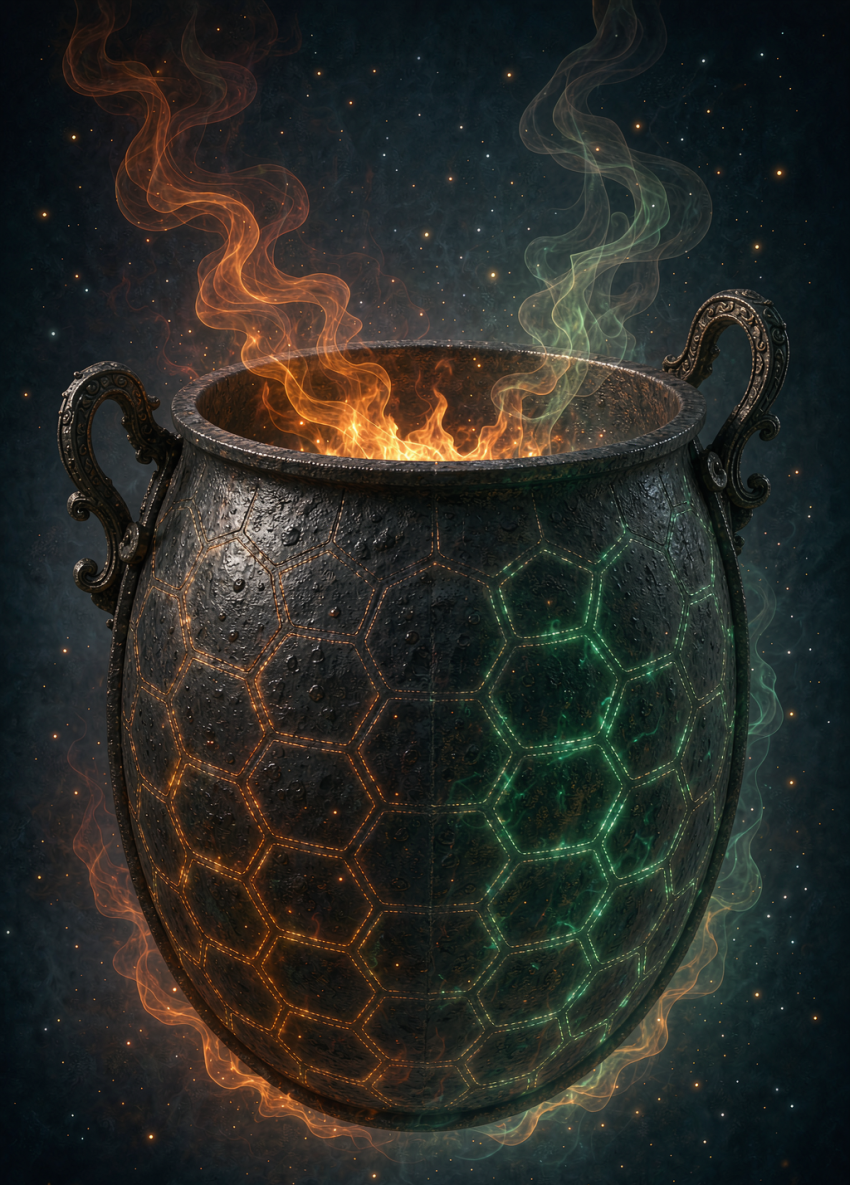
Bai Xiaochun’s wok: oval, turtle-shelled in shape, covered in dozens of faint lines that light up one by one when the correct grade of fire burns beneath it. Each lit line enables one round of Spirit Enhancement.
Two layers of meaning are stacked in it:
- The turtle (龟). In Chinese culture the turtle is the emblem of longevity — the creature that lives longest, and a standard symbol in blessings for a long life. Bai Xiaochun chose the wok because it looked lucky for someone who wants to live forever. He is correct, and the joke is that the lucky object charges him in exactly what it promised to protect.
- The wok itself. Via the 背锅 pun above, the wok is the badge of the scapegoat. Bai Xiaochun’s most powerful artifact is, literally and figuratively, a mark of taking the blame — a debt instrument disguised as cookware.
一色火 / 二色火 / 三色火 (YĪ / ÈR / SĀN SÈ HUǑ) — Flame Grades
Category: 概念 · Alchemical grading
Flames in this world are graded by how many colors they burn with. Higher grade = hotter = required for higher-tier Spirit Enhancement.
| Grade | Fuel source |
|---|---|
| One-color fire | Common spirit wood |
| Two-color fire | Rarer purple wood |
| Three-color fire | The tail of a Spirit-Tailed Chicken (灵尾鸡) |
The system creates a hard supply bottleneck: Bai Xiaochun can enhance freely only as long as he can source better fire. This is why the chicken theft of chapters 19–26 is not filler comedy — it is supply-chain procurement, and the chickens are the only source of the fuel he needs to keep progressing.
灵尾鸡 (LÍNGWĚI JĪ) — The Spirit-Tailed Chicken
Category: 器物 / 灵兽 · Resource
A rare spirit-bird whose tail burns with three-color fire — the fuel for third-tier Spirit Enhancement. It is also, being a spirit creature, extremely nourishing to eat.
Two cultural notes make it funnier and more coherent:
- Chicken as the classic livestock. In Chinese village life the household chicken is the archetypal small property — the thing a thief steals, the thing a family counts. The novel is riffing on a very old rural trope.
- The dual use. The chicken provides both the fuel for enhancement and the vital energy Bai Xiaochun needs to survive his own body-refinement art. It is simultaneously a resource node and a food source — which is why the entire sect mobilizes to catch the thief who raids it.
延年益寿丹 (YÁN NIÁN YÌ SHÒU DĀN) — The Longevity Pill
Category: 器物 · Pill
A pill that grants one extra year of life. The name is a four-character blessing-phrase: 延年 (“prolong years”) + 益寿 (“add to lifespan”) — the same words on countless Chinese birthday scrolls and greeting cards.
Its restrictions are what make it matter:
- Only works below 凝气五层 (Qi Condensation Layer 5).
- Only the first pill has any effect.
- It is expensive.
The sect issues it mainly to disciples who want to extend the lives of their elderly mortal parents — a detail that tells you everything about this world’s values. In a setting where cultivators can live for centuries, the pill exists for the sake of the ordinary people who cannot. For Bai Xiaochun, who has just spent a year of his own life on the wok, it becomes an obsession.
天材地宝 / 灵米 (LÍNG MǏ) — Spirit Rice
Category: 器物 · Food as resource
A single grain of 灵米 — spirit rice — is a thumb-sized, translucent, fragrant grain that carries concentrated qi. Eating it adds cultivation, which is why it is a reward and why the Fire Kitchen’s daily access to such ingredients is such a cushy perk.
Food-as-cultivation-resource is a small but constant theme: eating well literally makes you stronger, so kitchen staff are sitting on a fortune. The line “better to starve in the Fire Kitchen” lands very differently once you realize nobody there is starving — they are eating the equivalent of investment-grade assets three times a day.
逆鳞 (NÌ LÍN) — The Dragon’s Reverse Scale
Category: 概念 · Idiom
The single inverted scale beneath a dragon’s chin that, if touched, sends the dragon into uncontrollable rage. In modern Chinese, 触碰逆鳞 means hitting someone’s one unforgivable button.
Bai Xiaochun’s reverse scale is death — anything that genuinely threatens his life flips a switch in him, converting the comic coward into a disproportionately dangerous opponent. The idiom matters because it explains the shape of his rage: it is not heroic anger, but the panic-threshold of a creature conditioned to survive at all costs.
天地 (TIĀNDÌ) / 大道 (DÀDÀO) — The Cosmic Frame
Category: 概念 · Cosmology
天地 is “Heaven and Earth” — the Chinese term for the totality of the ordered universe, without implying a creator. 大道 is “the Great Way” — the underlying law of that universe.
Why this matters for reading the novel: there is no god to negotiate with in this setting. Transgression is not sin; it is an imbalance in a system that self-corrects. When Bai Xiaochun steals Heaven’s power through the wok, no one judges him. The universe just presents a bill in lifespan, automatically and without malice.
That is a fundamentally Chinese narrative logic — closer to physics than to theology — and it is why the novel can be simultaneously a comedy and a meditation on the cost of power without ever needing a villain to embody the cost.
Quick Index (Chapters 1–10)
| Concept | Pinyin | Type | One-line function |
|---|---|---|---|
| 长生 | chángshēng | Concept | Physical immortality as a project |
| 仙 | xiān | Archetype | The goal-state; an overworked senior, not a god |
| 一炷香 | yī zhù xiāng | Unit | Half an hour, measured by burning incense |
| 香 | xiāng | Ritual object | Incense as a transmission medium |
| 凡人 / 修士 / 仙人 | fánrén / xiūshì / xiānrén | Social order | Three tiers; the mortal’s closed lifespan ledger |
| 凝气 | níng qì | Realm | First realm, ten layers; Layer 3 is the gate |
| 修炼 | xiūliàn | Method | Artisanal practice, not study |
| 气 | qì | Metaphysics | Life energy; stamina + vital force, not mana |
| 丹田 | dāntián | Anatomy | The “elixir field” — body as farmland |
| 经脉 | jīngmài | Anatomy | Qi routes; a technique is a circulation program |
| 天材地宝 | tiāncái dìbǎo | Resource class | Heaven’s materials — the universe’s property |
| 炼灵 | liàn líng | Mechanic | Forcing spirit into matter; the theft |
| 寿元 | shòuyuán | Currency | Drainable lifespan; the moral core |
| 天地不允 | tiāndì bù yǔn | Cosmic law | No lawgiver; automatic rebalancing |
| 鼎 | dǐng | Artifact | Ritual vessel + sovereignty + alchemy |
| 紫气 | zǐ qì | Symbol | The purple-qi omen of a sage’s arrival |
| 举重若轻 / 举轻若重 | jǔ zhòng ruò qīng / jǔ qīng ruò zhòng | Idiom pair | Effortless power + total precision |
| 道 | dào | Philosophy | The natural order; alignment vs. forcing |
| 鱼跃龙门 | yú yuè lóngmén | Idiom | The one jump out of your class |
| 坊市 | fāngshì | Institution | The grey-market trade district |
| 灵石 | língshí | Currency | Money that is also fuel |
| 贡献点 | gòngxiàndiǎn | Currency | Institutional credit; non-fungible privilege |
| 杂役 / 外门 / 内门 | záyì / wàimén / nèimén | Hierarchy | Outer vs. inner = how far inside you’re allowed |
| 师兄 / 师弟 / 师姐 / 师妹 | shīxiōng / shīdì / shījiě / shīmèi | Address | Seniority by entry order, not age |
| 掌门 / 掌座 / 长老 / 执事 | zhǎngmén / zhǎngzuò / zhǎnglǎo / zhíshì | Offices | Sect as university + corporation |
| 火灶房 | huǒzàofáng | Institution | The cushy kitchen; the scapegoat division |
| 龟纹锅 | guīwén guō | Artifact | Longevity emblem + scapegoat badge |
| 一/二/三色火 | yī / èr / sān sè huǒ | Grading | Fire tiers; the supply bottleneck |
| 灵尾鸡 | língwěi jī | Resource | Three-color fire fuel + food |
| 延年益寿丹 | yán nián yì shòu dān | Pill | One year of life; for mortal parents |
| 灵米 | líng mǐ | Food | Spirit rice; food as cultivation asset |
| 逆鳞 | nì lín | Idiom | The unforgivable button; death is his |
| 天地 / 大道 | tiāndì / dàdào | Cosmology | Physics, not theology — no one to negotiate with |