


A Will Eternal — Chinese Cultural Concepts (Chapters 11–20)
What this is: a reference list, not a summary. These are the Chinese cultural concepts, objects, and ideas that appear in chapters 11–20 of A Will Eternal and that a Western reader has no way to decode from context. Each entry explains where the concept comes from in Chinese culture, why the English translation cannot carry it, and what it is doing in the novel.
How to use it: read an entry when a chapter throws a term at you that the translation leaves unexplained. Concepts are grouped roughly by the chapter where they first matter.
鱼跃龙门 (YÚ YUÈ LÓNG MÉN) — “A Fish Leaps the Dragon Gate”
Category: 成语 · Social mobility
The phrase Bai Xiaochun shouts at every ascension is one of the most loaded idioms in Chinese. It comes from a folk legend: if a carp can leap the Dragon Gate — a waterfall on the Yellow River — it transforms into a dragon.
In the imperial era the idiom became the standard metaphor for passing the highest civil-service exam. It is not “getting a promotion.” It is the one jump that changes your species — the single moment when a person of no birth escapes their class forever.
That is exactly what the trial road is. A 杂役 (menial disciple) touching the top step becomes a 外门弟子 (outer-sect disciple), and in this society that is a one-way door. Only one candidate per month may pass. So when Bai Xiaochun sells his own slot, he is not selling a ticket — he is selling someone else’s species change, and the people bidding are bidding on the only upward door they will ever see.
Why the translation fails: English “fish jumps over the dragon gate” reads as a quirky proverb. In Chinese it lands with the full historical weight of an exam-and-class system that decided the fate of every family for a thousand years.
师兄 / 师姐 / 师兄妹 — The Seniority System
Category: 概念 · Social structure (expanded)
Chapter 11 opens with the joke that has run since chapter 1 and finally pays off in chapter 14: 黑三胖, the “third senior brother,” is actually a woman — and therefore 师姐 (shījiě), not 师兄 (shīxiōng).
This only works as a joke because of how the words function. In Chinese sect culture, 师-address is ordered by the date you entered the sect, not by age and not by gender first. The first character 师 (shī, “master/teacher”) marks the shared lineage; the second marks rank (兄 xiōng = elder brother, 弟 dì = younger brother, 姐 jiě = elder sister, 妹 mèi = younger sister).
| Term | Literal | Actually means |
|---|---|---|
| 师兄 / 师姐 | “senior brother / sister” | Anyone who entered before you |
| 师弟 / 师妹 | “junior brother / sister” | Anyone who entered after you |
So a 60-year-old man who joined last week is your 师弟, and a teenage girl who joined first is your 师姐. The 火灶房 group — Big Fatty Zhang (大师兄), Black Three (三师兄/三师姐), and Number Nine (九师弟) — is a cohort sorted by join date, not a family.
Why it matters: the entire warmth of the novel’s found-family is built on this. Bai Xiaochun’s “senior brothers” are simply people who happened to arrive earlier, which is why the bond feels chosen rather than given.
篱笆墙 (LÍBA QIÁNG) — The Fence-Top Pose
Category: 器物 / 意象 · A running image
Chapter 12 ends with Bai Xiaochun standing on the courtyard fence wall, hands behind his back, sleeves fluttering, staring into the distance:
“With a flick of my finger, Bai Xiaochun reduces the Supervisory Office to ashes…”
The fence is doing specific cultural work. In Chinese martial-arts (武侠) iconography, the lone figure standing on a wall or rooftop, robe in the wind, contemplating the world is the visual shorthand for the accomplished master — the 高手 who has transcended the small squabbles below.
Bai Xiaochun is a 15-year-old cow secretly stealing chickens, and he strikes this pose to celebrate beating up bureaucrats. The comedy is that the visual vocabulary of the transcendent swordsman is being applied to the most petty, most self-satisfied coward in the book. Watch for the pose’s return in nearly every victory scene — it is his trademark.
监事房 / 执法堂 / 门规 (JIĀNSHÌFÁNG / ZHÍFǍTÁNG / MÉNGUĪ) — Sect Bureaucracy
Category: 机构 · Institution
Chapter 12 introduces the machinery by which a cultivation sect actually runs. These are not mystical terms — they are administrative offices translated with deliberate banality, and that banality is the point.
| Term | Literal | Function |
|---|---|---|
| 监事房 (jiānshìfáng) | “Supervisory Office” | Mid-level enforcers; can question but not arrest |
| 执法堂 (zhífǎtáng) | “Law-Enforcement Hall” | The sect’s police; can punish, exile, or kill |
| 门规 (ménguī) | “Sect regulations” | The written legal code, cited by volume and article |
| 长老 (zhǎnglǎo) | “Elder” | Sect leadership; here also the task examiner |
The comedy of chapters 12–13 is legalistic, not mystical. Bai Xiaochun has read the 门规 cover to cover, discovers there is no rule against selling ascending slots, and then counter-attacks Big Sister Chen by citing 门规第九卷第十一条 (Regulation Vol. 9, Art. 11) — abuse of Supervisory Office authority. The sect is a bureaucracy with a rulebook, and the book’s cleverest character wins by knowing the bylaws better than the enforcers.
Why the translation fails: rendered as “courtyard” or “hall,” the words lose the flavor of a modern administrative state wearing Taoist robes.
一炷香 (YĪ ZHÙ XIĀNG) — “One Stick of Incense” (recurrence)
Category: 器物 / 计时单位 · Timekeeping
The unit returns constantly in this arc, and it matters more than ever, because it is also the interval of the secret trial.
Two things happen at once in the phrase:
- As a clock: one stick ≈ 30 minutes. “After one stick of incense” (一炷香后) genuinely means half an hour passed — in chapter 20, Bai Xiaochun uses “wait one stick of incense” as a real promise of time to steal chickens and return.
- As a stage direction for ritual: when 周心琪 repeatedly enters the trial hut to retake the plant-reassembly test, each attempt is narrated as 一炷香 — she is burning through half-hour blocks, twenty-plus times across days, refusing to accept the turtle-marked defeat.
Watch for the anti-collocation: in chapter 18, the crowd says “this first-place rank will only survive 一炷香” — meaning “you’ll be dethroned in half an hour,” a confident social taunt, not a measure of meditative stillness.
香 (XIĀNG) — Incense as Medicine, Seal, and Signal
Category: 器物 · Ritual (expanded)
Chapters 14–18 expand incense from a “letter to an immortal” into a multi-purpose technology:
| Use of 香 | Meaning |
|---|---|
| 传信香 | A burned message sent to a distant being |
| 升青香 (shēng qīng xiāng) | A pill-substitute: inhale the smoke to gain qi |
| 凌云香 (líng yún xiāng) | A first-tier alchemical drug worth a fortune |
| 墨灵香 (mò líng xiāng) | The exam drug, made from herbs; a ranking benchmark |
The deep cultural base: in Chinese practice, what you burn, you consume spiritually. Burning incense is not decoration — it is transmitting or ingesting something. So in this world, a cultivator who cannot swallow a pill may instead burn incense and breathe it in to absorb its power (chapter 16, when Bai Xiaochun breaks through to Qi Condensation Layer 4). Incense is simply a slower, airborne form of eating.
玉简 (YÙJIǍN) — The Jade Slip
Category: 器物 · Information technology
The 玉简 is the book, hard drive, and contract of the cultivation world — a palm-sized jade tablet that stores information spiritually.
In this arc alone it is used to:
- hold the registrar’s test (chapter 17) — a slip you inject into a stone to be examined;
- store the one thousand (then ten thousand) herbs a novice must memorize (chapter 16);
- serve as the official record of a plant-reassembly score, later used as evidence in a bet (chapter 25/29).
Why Western readers need the note: 「玉简」 is often translated “jade slip,” which sounds ornamental. Functionally it is the era’s USB stick — a standardized, implantable, read/write data object. When Bai Xiaochun can “see” a jade slip’s contents in his mind, that is normal operation, not magic.
灵童 / 药徒 / 药师 (LÍNGTÓNG / YÀOTÚ / YÀOSHĪ) — The Alchemist’s Ladder
Category: 机构 / 职级 · Profession ranks
Xiangyun Mountain trains alchemists, and it has its own promotion ladder, introduced through Hou Yunfei’s farewell speech:
| Rank | Meaning | Gate |
|---|---|---|
| 灵童 (língtóng) | “Spirit-child” — apprentice who memorizes herbs | Memorize the 10,000-herb jade slip |
| 药徒 (yàotú) | “Medicine-pupil” — can brew first-tier pills | Pass the 5-slip + brewing exam |
| 药师 (yàoshī) | “Medicine-master” — a true alchemist | Mastery; only two in the whole Eastern Forest Prefecture |
Note the Confucian shape of the ladder: 童 → 徒 → 师 is the same progression as student → apprentice → master, and it mirrors the traditional mentor–disciple (师徒) bond at the heart of Chinese craft culture. 李青候 is the only 药师 of the territory; 周心琪 is his designated heir. When Bai Xiaochun shouts “I will become a Medicine Master and make an immortality pill!” (chapter 15), he is declaring a career, not casting a spell.
不死长生功 (BÙ SǏ CHÁNGSHĒNG GŌNG) — The “Undying Long-Life Art”
Category: 概念 / 功法 · Cultivation method
The technique Bai Xiaochun picks up in chapter 15 is not magic — it is gymnastics and self-flagellation performed as body-forging, and it appears only as a fragment (残篇), missing half its chapters.
Its name encodes its promise: 不死 (not-dying) + 长生 (long-life) + 功 (art). The novel treats it as a brutal exercise regime whose price is paid in pain:
| Stage | Chinese | Western reader’s mistake |
|---|---|---|
| 外炼 皮肉筋 | “outer refine: skin/flesh/sinew” | Think “training” — not “strengthening” |
| 内炼 骨血 | “inner refine: bone/blood” | The remaining half, never given |
| 小周天 | “small heavenly circuit” | Not meditation — here, a completed 81-day physical loop |
The recurrence of 九九八十一 (81) — 81 days, 81 cycles — is the same “ultimate completion” number that appears in Journey to the West (the 81 tribulations). To finish 81 is to finish everything that stage requires.
Why it reads oddly in English: the translation “Undying Long-Life Art” sounds like an instant-immortality cheat. It is the opposite: a long, agonizing, resource-hungry grind that the sect abandoned centuries ago because it is economically irrational. That is why it was sitting unclaimed on a shelf — and that is the irony the whole arc runs on.
龟纹锅 (GUĪWÉN GUŌ) — The Turtle-Pattern Wok
Category: 器物 · Artifact (expanded)
The wok Bai Xiaochun found in the Fire Kitchen returns as the single most important object in the novel so far, and chapters 16–18 reveal exactly how it works as a refining (炼灵) engine:
| Fire color | Fuel source | Effect |
|---|---|---|
| 一色火 (one-color) | common wood | One spirit-refinement pass |
| 二色火 (two-color) | special wood | Two passes |
| 三色火 (three-color) | the tail-feather of the Spirit-Tailed Chicken | Three passes — the maximum |
Three passes (炼灵三次) is the ceiling the novel has shown so far, and it multiplies any object’s power. Bai Xiaochun uses it on pills (chapter 15–16), on spirit-soil for his garden (chapter 16), on his wooden sword and jade pendant (chapter 29), and even on his leather clothing (chapter 46).
The turtle motif is not incidental — in the entries on 长生, the tur是 standard symbol of longevity, which is precisely what Bai Xiaochun is hunting. His chosen alchemist’s seal (chapter 17) is a turtle, drawn crookedly, later to become the most famous anonymous mark in the sect.
Cultural note: Chinese mythology’s four spiritually-noble creatures are the dragon, phoenix, qilin, and turtle — the turtle is not a slow joke, it is the oldest symbol of endurance and long life in the canon.
灵冬竹 (LÍNG DŌNG ZHÚ) — Spirit-Winter Bamboo
Category: 器物 / 资源 · Resource
The herb Bai Xiaochun is assigned to grow for a sect task (chapter 16) is a natural object whose value is measured in inches of height.
| Height | Rating | Chinese term |
|---|---|---|
| 半丈 (“half a zhang” ≈ 1.6 m) | Very good | 上上品 |
| 一丈 (one zhang ≈ 3.3 m) | Excellent — “the limit for a Qi-Condensation disciple” | 佳品 |
| 五丈 (five zhang ≈ 16 m) | Legendary — one is enough to forge spirit-bamboo swords | 极品 |
Note the unit: the 丈 (zhàng), a traditional Chinese measure ≈ 3.33 metres. “Two zhang of bamboo” is not a jogging trail — it is a tower.
Bai Xiaochun grows five-zhang bamboo by accident, because he has been refining his garden’s spirit-soil with the wok and feeding it with hundreds of buried chicken bones. The old registrar’s horror when he finds a bite mark in it (chapter 28) is the punchline: no one in a millennium has produced 极品 bamboo, and this child has chewed on it.
灵尾鸡 (LÍNG WĚI JĪ) — The Spirit-Tailed Chicken
Category: 资源 / 器物 · Resource (expanded)
The chicken returns as the arc’s comic engine and as a three-purpose resource:
- Meat — a bowl of it refills the body’s 元气 (vital essence) after an Undying Long-Life cycle, exactly what a starving body forger needs;
- Tail-feathers — the only source of 三色火 (Triple-Color Fire), i.e. the top-grade wok fuel;
- Eggs and blood — alchemical ingredients.
The chickens are owned privately by 李青候 and the other Mountain Lords (掌座), which is why the theft is a social catastrophe and not just a crime. Chapter 20 has Bai Xiaochun construct the classic 竹知了 (bamboo cicada) — a bamboo noose-trap baited with spirit-insects, learned from his father — and begin the “Chicken-Thief Fiend” (偷鸡狂魔) legend.
Why it’s funny to a Chinese reader: the 灵尾鸡 is a cultivation-world substitute for the village chicken — the lowest, most ordinary of all farm birds, elevated to spirit-beast status. A “Chicken-Thief Fiend” is a mythic terror whose name is ultimately “the guy who steals farm birds.”
九九八十一 (JIǓ JIǓ BĀ SHÍ YĪ) — “Nine-Nines, Eighty-One”
Category: 概念 · Numerology
The number surfaces explicitly in this arc and governs the entire Undying Long-Life schedule:
- 81 cycles = one 小周天 (small heavenly circuit);
- 81 days of pain, then 81 days of hunger;
- 81 bursts of vital essence to achieve 不死铁皮 (Undying Iron Skin).
Where “81” comes from: in Chinese cosmology, 9 is the ultimate yang number, and 9×9=81 is therefore “completion of completion.” Journey to the West headlines 九九八十一难 — the 81 tribulations a pilgrim must endure to be sanctified. Achieving something in 81 installments means you have run the full course of a trial. Writers use it whenever a process is meant to be maximally arduous but finite.
Why it matters here: the number tells the reader that Bai Xiaochun’s body-forging is not “hard training” — it is a scripture-length ordeal, and he is too stubborn to quit. The joke (and the character) lands only if you hear “81” and think the mythic full count.
碎喉锁 (SUÌ HÓU SUǑ) — “Throat-Crushing Lock”
Category: 武功 / 技法 · Hidden technique
When Bai Xiaochun completes Undying Iron Skin, the fragment grants him a named secret finger-technique (chapter 25): he pinches thumb-and-index, black light flickers, and whatever he grips shatters — rock, bamboo, later a shield.
The name is a threat in two characters: 碎 (shatter) + 喉 (throat) + 锁 (lock/grip). It is a killing grip aimed at the throat. The novel carefully frames this as 杀人秘法 — a murder technique — and gives its first demonstration on a boulder and a bamboo stalk, so the reader feels the lethality without yet seeing it used on a person.
Cultural note: Chinese 武侠 shares the “hidden lethal hand” trope (dianxue 点穴, claw techniques), where a fingertip is deadlier than a sword. The novel is borrowing that tradition and attaching it to a body-forging art — you break people with your bare fingers.
万蛇谷 (WÀN SHÉ GǓ) — Ten-Thousand Snake Valley
Category: 地理 · Location / threat
Li Qinghou’s punishment-scene in chapter 26 uses a location whose name is the threat: 万 = ten thousand (uncountable), 蛇 = snake, 谷 = valley.
It is the sect’s poison-collection site, and the novel establishes its danger with concrete rules:
- one drop of a snake’s venom kills a hundred oxen;
- anything below 筑基 (Foundation Establishment) touched by it dies without immediate rescue;
- the deep valley holds a snake-king that even Li Qinghou cannot save you from.
Three-color snakes at Qi-Condensation Layer 5, and a four-colored one further in — the color-code of danger.
Cultural weight: “ten thousand X” (万X) is the standard Chinese hyperbole for innumerable. And the snake-as-trial-terrain draws on a long tradition (the 白蛇 and toxic-valley imagery of early Daoist geographies), where the place itself is the punishment — you are sent to nature to be disciplined.
举重若轻 / 举轻若重 (JǓ ZHÒNG RUÒ QĪNG / JǓ QĪNG RUÒ ZHÒNG) — The Mirrored Heavenly Passes
Category: 成语 / 境界 · Concept pair
This is the arc’s philosophical centrepiece, introduced in chapter 29 and completed in chapter 37, and it is almost always mistranslated as two opposite idioms. It is the reverse: a matched pair describing the two halves of perfect qi-control.
| Idiom | Literal | In the novel’s own definition |
|---|---|---|
| 举重若轻 | “lift heavy as if light” | Moving a massive object with effortless, unbroken, stable qi |
| 举轻若重 | “lift light as if heavy” | Handling a trivial object with total precision and weight |
Bai Xiaochun’s breakthrough comes when he stops treating it as a statement about objects and realizes it is a statement about the qi thread:
“My total qi at Layer 5 is the ‘heavy.’ Turning it into a thin but unbroken thread is the ‘light.’ Do that, and you have 举重若轻 — and the outward sign is the freedom and speed of the control.” — chapter 29
Where the pair originates: it is a real Chinese literary idiom about mastery expressed as ease. A master calligrapher’s brush “lifts heavy as if light” (power without strain, 举重若轻); a master swordsman’s blade “lifts light as if heavy” (a feather-stroke carrying full intent, 举轻若重). Master both and you have perfect control.
In-world payoff: mastering both fuses them into a single divine ability of the sect’s foundational art — 紫气化鼎 (Purple Qi Transforms into a Cauldron) — see the next entry.
紫气驭鼎功 (ZǏ QÌ YÙ DǏNG GŌNG) — “Purple Qi Drives the Cauldron Art”
Category: 功法 · Method
The sect’s basic, universal cultivation method, which every disciple on the southern shore of the sect learns. The name decodes as:
- 紫气 — “purple qi,” the auspicious vapour said to herald a sage’s arrival (from the Daodejing legend: purple clouds over the pass as Laozi departed);
- 驭 — “to drive / command,” the same verb used for driving horses;
- 鼎 — the ritual bronze cauldron (see the 鼎 entry in Chapter 1–10);
- 功 — “art.”
So the whole title reads: “the art of commanding the cauldron with purple qi” — a ritual instrument manipulated by the most auspicious energy in the cosmos.
Its structure matters: the art has ten diagrams / layers (第一至第X幅图), taught one at a time from a jade slip. Layer advancement is physical posture training — a disciple literally contorts into each diagram’s shape.
Why Western readers slip: “drives the cauldron” sounds like witchcraft. It is a body-cultivation syllabus whose final move is an offensive technique.
紫气化鼎 (ZǏ QÌ HUÀ DǏNG) — “Purple Qi Transforms into a Cauldron”
Category: 神通 · Technique
The single divine ability hidden in the basic method, unlocked only by mastering both 举重若轻 and 举轻若重 (chapter 38).
Bai Xiaochun draws qi-threads into the shape of a bronze cauldron in the air, pours in 80% of his total qi, then drops it — and the impact cracks the ground for a hundred metres.
Three observations that only make sense with cultural context:
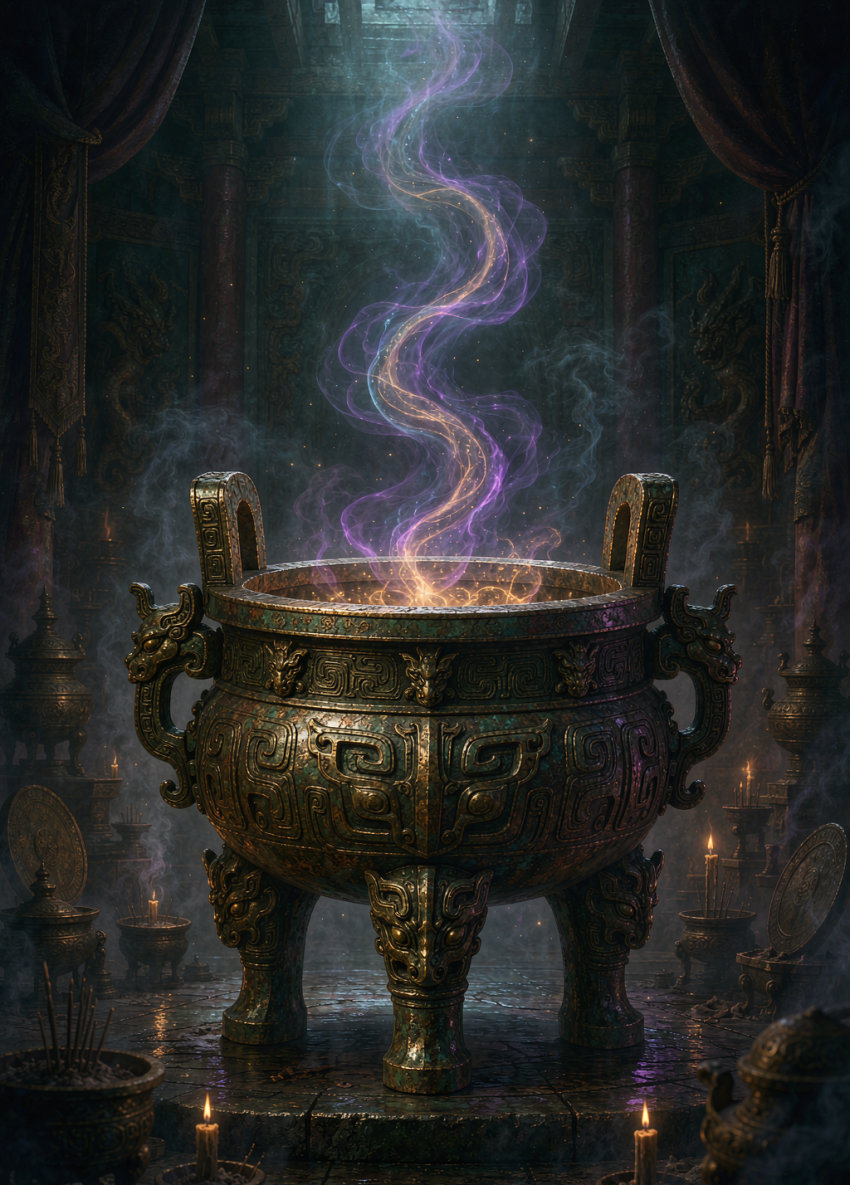
- The weapon is a ritual vessel. The most sacred object in Chinese bronze-age ceremony — the 鼎 that represents dynastic authority — is here used as a falling hammer. The image is “an emperor’s sacred cauldron dropped on your head.”
- It is graded 上/中/下品 (upper/middle/lower) — a Confucian-style quality ranking applied to a technique. Lower grade = one cauldron; upper grade = three cauldrons that merge into one great cauldron.
- It is ruinously expensive. Most disciples cannot fuel it before Qi-Condensation Layer 9. The novel shows that Bai Xiaochun can, because his qi is unusually compressed/pure — a payoff of the wok’s refining.
幻境考核 / 万药阁石碑 (HUÀNJÌNG KǍOHÉ / WÀNYÀO GÉ SHÍBĒI) — The Ten Stele Hall
Category: 机构 · Institution / test
The Hall of Ten Thousand Medicines (万药阁) is Xiangyun Mountain’s alchemy hub, dominated by ten giant stone steles (石碑), each a leaderboard.
How the test works (chapter 17–18):
- You place your name-token on a desk; a light flashes; you enter a hut (木屋) at the base of a stele;
- Inside, you press your hand to a small stele and are drawn into an illusion space (虚幻空间);
- A cold voice gives the task: “Within one stick of incense, reassemble shattered herbs; the more complete ones, the better.”
- Thousands of herb-fragments lie mixed; you point, and matching pieces fly together into whole plants.
Your score ranks you on the stele, and every alchemist has a personal seal (印记) — a personal emblem stamped onto the pills they are proud of, to be “transmitted through the ages.” The top of every stele shows a seal, not a name.
Why this matters: it is a public, permanent credit system. A disciple’s worth is literally carved in stone, sealed with a personal emblem, and read by everyone. When a crooked turtle appears above 周心琪’s jade vase (chapter 18), the entire mountain talks of nothing else — the anonymous “Turtle Pharmacist” (龟药师) is born.
药童 / 印记 / 青出于蓝 (YÀOTÓNG / YÌNJÌ / QĪNG CHŪ YÚ LÁN) — The Herb-Master’s Craft
Category: 概念 · Craft culture
This arc is largely about the aesthetic and ethics of the herb-master’s craft, rendered through three recurring ideas:
| Idea | Meaning |
|---|---|
| 药童 (yàotóng) | “medicine-child” — a disciple who tends and knows plants |
| 印记 (yìnjì) | A personal seal, the alchemist’s signature |
| 见微知全 (jiàn wēi zhī quán) | “see the small, know the whole” — the master’s skill |
The phrase 见微知全 is the arc’s thesis for Bai Xiaochun’s talent: he studies each herb so minutely — down to the fuzz on the leaves and the pores beneath the fuzz — that he can reverse-engineer a hybridized plant into its components (chapter 34). The idiom is Confucian-Daoist in origin: the greatest understanding begins with the smallest observation.
There is also a beautiful pun the translation cannot carry — 青出于蓝而胜于蓝 (qīng chū yú lán ér shèng yú lán), literally “blue-green comes from the indigo plant but is bluer than it.” It is a standard idiom meaning “the student surpasses the master,” and in chapter 33 it appears as a literal plant: Bai Xiaochun reveals his “blue spirit-flower” was actually a green (青) spirit-flower (青灵花) all along — the disciple out-shining the dye is literally the flower turning from blue to green. A translation can render the pun’s words but never its double meaning.
杂役 / 外门 / 内门 / 洞府 (ZÁYÌ / WÀIMÉN / NÈIMÉN / DÒNGFǓ) — The Sect’s Spatial Hierarchy
Category: 概念 · Social structure (expanded)
Chapters 14–15 reveal that sect rank is expressed as geography:
| Rank | Chinese | Where they live |
|---|---|---|
| 杂役 | menial | The menial districts at the foot of the mountain |
| 外门弟子 | outer-sect disciple | A courtyard compound (院子) on the mountain’s lower/middle slopes |
| 内门弟子 | inner-sect disciple | A grotto-dwelling / cave mansion (洞府) in the upper half of the peak |
The mountain is a vertical map of status: the higher you rank, the higher you live, and the better the ambient qi. Bai Xiaochun notes in chapter 15 that “only inner-sect disciples may dwell on the mountain’s upper half.”
Cultural note: the 洞府 (dòngfǔ) — “cave mansion” — is a stock item of Chinese immortal fiction, inherited from Daoist hermits who actually secluded in mountain caves. A 洞府 is not poverty; it is the most prestigious housing in the world, a private sanctum cut into sacred rock.
秘法 / 小周天 / 小循环 (MÌFǍ / XIǍO ZHŌUTIĀN / XIǍO XÚNHUÁN) — Body-Forger’s Vocabulary
Category: 概念 · Cultivation mechanics
The Undying Long-Life arc invents a small, precise vocabulary that the translation often flattens:
| Term | Literal | Meaning here |
|---|---|---|
| 秘法 (mìfǎ) | “secret method” | A named finisher move inside a technique (e.g. 碎喉锁) |
| 小循环 (xiǎo xúnhuán) | “small cycle” | One full day-and-night of a prescribed action |
| 小周天 (xiǎo zhōutiān) | “small heavenly circuit” | 81 small cycles = one complete stage |
| 灭相 (miè xiàng) | “destruction-mark” | The cracking of the skin that must be endured to finish perfectly |
| 不死铁皮 (bù sǐ tiě pí) | “undying iron skin” | The grade achieved at completion |
小周天 (small heavenly circuit) is not the ordinary Daoist meditation term here — it has been repurposed to mean “81 repetitions in sequence.” The book’s rule is that the more of the 81 bursts you can endure without fainting, the better the final skin. This converts a mystical-sounding word into a stamina test with a quality score, which is entirely the novel’s humor: the holiest vocabulary becomes gym metrics.
偷鸡狂魔 (TŌU JĪ KUÁNG MÓ) — “The Chicken-Thief Fiend”
Category: 概念 · Nickname / legend
A standard structure in Chinese jianghu naming: action + 狂 (mad/frenzied) + 魔 (demon). It is the register of legends and terrors — a name that, by itself, tells you the person is a monster beyond reason.
The joke is that the monster is a 15-year-old who steals farm birds at night using a bamboo noose, and whose motivation is chronic starvation from a body-forging technique. Chapter 25 expands the legend: the thefts spread from Xiangyun to Purple Cauldron to Green Peak Mountain, and the sect concludes there must be two fiends, not one.
Why it lands differently in Chinese: 魔 carries real weight — it is the māra of Buddhism, the tempter/demon. Naming a chicken thief 魔 is exactly the mock-epic register the book’s whole comedy is written in: mythic language, petty deeds.
灵石 / 贡献点 (LÍNGSHÍ / GÒNGXIÀNDIǍN) — The Two Currencies (expanded)
Category: 货币 · Currency
Chapters 11–16 run both currencies through their paces and clarify their difference:
| 灵石 (spirit stones) | 贡献点 (contribution points) | |
|---|---|---|
| Nature | Physical ore; currency + fuel | Sect ledger credit; non-transferable account |
| Earned by | Selling slots, killing beasts, market trade | Completing sect tasks (任务) |
| Spent on | Anything, anywhere | Only inside the sect — spells, pills, materials |
| Real-world analogue | Cash / gold bullion | Airline miles / supermarket loyalty points |
Chapter 22 shows how the sect forces you to serve it: disciples must complete a task every six months (or yearly), or lose rank. Chapter 28 shows a windfall — one legendary bamboo earns 10,000 contribution points, vs. the usual 10–100. And the arc makes the ledger mean something: 5,000 points is the prize for the top alchemy exam, and Bai Xiaochun chases it not from greed but because points, unlike spirit stones, buy what he cannot otherwise reach.
Quick Index (Chapters 11–20)
| Concept | Pinyin | Type | One-line function |
|---|---|---|---|
| 鱼跃龙门 | yú yuè lóng mén | Idiom | The single species-changing jump; the one-way door |
| 师兄 / 师姐 | shīxiōng / shījiě | Address | Seniority by join date; the Black-Three reveal |
| 篱笆墙 | líba qiáng | Image | The fence-top master pose, worn by a chicken thief |
| 监事房 / 执法堂 / 门规 | jiānshìfáng / zhífǎtáng / ménguī | Institutions | Sect as bureaucracy; wins by citing the bylaws |
| 一炷香 | yī zhù xiāng | Unit | Half an hour; also the trial interval |
| 香 | xiāng | Ritual object | Incense as letter / medicine / seal / signal |
| 玉简 | yùjiǎn | Artifact | Storage medium / the era’s USB stick |
| 灵童 / 药徒 / 药师 | língtóng / yàotú / yàoshī | Ranks | Student → apprentice → master alchemist |
| 不死长生功 | bù sǐ chángshēng gōng | Method | Body-forging as torture; the abandoned art |
| 龟纹锅 | guīwén guō | Artifact | Spirit-refining engine; three-pass multiplier |
| 灵冬竹 | líng dōng zhú | Resource | Value by height; five-zhang = legendary |
| 灵尾鸡 | líng wěi jī | Resource | Meat + triple-color fuel + ingredients |
| 九九八十一 | jiǔ jiǔ bā shí yī | Numerology | Completion number; the full ordeal |
| 碎喉锁 | suì hóu suǒ | Technique | Bare-finger lethal grip |
| 万蛇谷 | wàn shé gǔ | Location | The punishment: a valley of vipers |
| 举重若轻 / 举轻若重 | jǔ zhòng ruò qīng / jǔ qīng ruò zhòng | Concept pair | Two halves of perfect qi-control |
| 紫气驭鼎功 | zǐ qì yù dǐng gōng | Method | Basic art: auspicious energy drives the ritual cauldron |
| 紫气化鼎 | zǐ qì huà dǐng | Technique | The divine ability; drop a sacred cauldron |
| 万药阁 / 幻境考核 | wànyào gé / huànjìng kǎohé | Institution | Ten-steles hall; reassemble herbs in an illusion |
| 青出于蓝 | qīng chū yú lán | Idiom | Student surpasses master — as a literal flower |
| 杂役 / 外门 / 内门 / 洞府 | záyì / wàimén / nèimén / dòngfǔ | Hierarchy | Vertical map of status; the cave mansion |
| 小周天 | xiǎo zhōutiān | Mechanics | 81 cycles = one completed stage |
| 偷鸡狂魔 | tōu jī kuáng mó | Nickname | Mock-epic terror name for a farm-bird thief |
| 灵石 / 贡献点 | língshí / gòngxiàndiǎn | Currency | Cash vs. loyalty points; the ledger binds |